Adam Schantz, Jr.

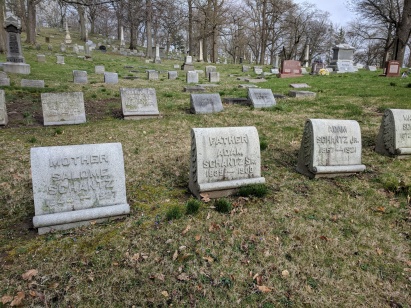
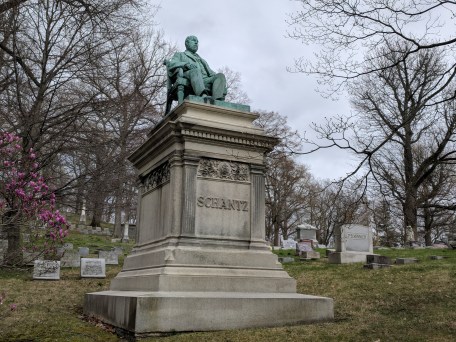
Adam Schantz, Jr. was born December 16, 1867 on River Street in Dayton, Ohio. Son of Adam Schantz, Sr. and Salome Schantz, he joined his father in the meat-packing industry at the age of twelve. Later on, he became the bookkeeper for the brewery run by his father and uncle. Once he turned twenty-one, he controlled almost all of his father’s interests.
IMG_20180416_173942

After Adam Sr. died, Adam Jr. became executor of the Schantz Estate. Adam Jr. was recognized as having made more changes to the Dayton skyline than anyone else. Ludlow Street was virtually rebuilt by him.
Continue reading

Liberty Tower

After the flood of 1913, Second Street faced a new frontier. As it had previously been occupied by mansions and apartment buildings, the flood pushed residents away from downtown, moving them to Salem Avenue and Far Hills Avenue. This created the prime opportunity for development.

Planning for the Liberty Tower started in 1929, and construction started the next year. It took 11 months to create what was Dayton’s tallest building at that time. Liberty Tower was the tallest building in Dayton from 1931 until the construction of the Kettering Tower in 1969. The Mutual Home Building, as it was known then, was built out of concrete and steel and 23 stories tall. Attendants manned the garages and state-of-the-art elevators, giving an air of elegance.

Continue reading

Interesting Street Names

  • Cline Street – Once known as Zigzag Street because it ran along an open ditch, called Seely’s ditch, but has long since been straightened.
  • Hoover Avenue – Not named for the president, but for local residents and the Hoover Park plat developed in 1917.
  • Demphle Avenue – named for Sebastion Demphle, a local stove dealer.
  • Babbitt Street – A T.S. Babbitt lived at First Street and Bridge Street, later Stratford Lane.
  • Kiefaber Street – named after Warner Harshman Kiefaber Sr, who graduated from St Mary’s Institute class of 1905 and later founded the W.H Kiefaber Company on Keowee Street and Monument Avenue in 1920.
  • Continue reading

Water you doing, Dayton?

In the late 1800s, sinks had 3 faucets. Far left was hot rainwater, far right was cold, and the middle was Holly Water. Also known as drinking water, Holly Water got its name because the first city waterworks used Holly’s Patent Elliptical Rotary Pumps to get water from two wells. The rainwater came from cisterns in people’s yards, collected from roof runoff and brought into the house via pumps.

Before Holly Water, residents drank well water, benefiting from the filtering effects of the porous sub-soil. By the 1860s as more and more people moved into Dayton, those water sources became compromised, with an increasing amount of cesspools infringing on the borders of these wells. This led to the first Board of Health being created in 1868. A Committee was formed to address the issues, ultimately choosing the “Holly System.”

Continue reading

45th Annual A World A’fair

To the lady who met Bethany’s mother at the base hospital yesterday: we would love to know who you are, and we thank you for your kind words!

Sara attended the annual A World A’Fair international festival on May 19th, and had a blast! This is one of our favorite events, and we look forward to it every year.

This slideshow requires JavaScript.

Oddball Street Names

A few odd street names in the Greater Dayton Area – some with an explanation, some just explain themselves!

  • Chicken Bristle Road, Farmersville: bristle is short, stiff hair. Chickens have bristle feathers.
  • Rip Rap Road, Huber Heights: Rip Rap is stone used to protect shore lines from erosion.
  • Grinn Drive and Barrett Road, West Chester: make up the intersection “Grinn and Barrett.”
  • Sweet Potato Ridge Road, Brookville
  • Dotcom Drive Troy: Named after the internet term.

Continue reading

Farmersville Bottle Farm

“I would live by my wits while my brothers live by the sweat of their brows.”– Winter Zellar (Zero) Swartsel, Grandfather of Pop Art

Tired of the hard-working routine of Farmersville, Zero and a friend decided to bike first to New York City, head west, then travel the world, collecting items along the way. Later, his home in Farmersville and also his yard would be decorated extensively with these items. His twenty-two acre farm soon became a canvas for his art, using glass he collected from “wasteful” people.

106097_119061
Source: Remarkable Ohio

Continue reading

Going Out With a Bang: My God, I’ve Shot Myself

Clement Vallandigham (July 29, 1820 – June 17, 1871)

It was going to be the biggest case of his life. Fifty year old Dayton Attorney Clement Vallandigham was to defend Thomas McGehan, who was charged with murder for a barroom brawl turned deadly in Hamilton, Ohio. Having been unable to find a jury un-swayed by newspaper reports in Hamilton, the trial moved to Lebanon.

Vallandigham and his partner, Daniel Haynes, formed a practice that had become “one of the best and ablest in the West”, with stories of Vallandigham making final pleas so persuasive that the jury was left in tears. Nobody researched more than he did, and he was adept at anticipating the rebuttal arguments of the opposing lawyers.

Continue reading