Come see Sara this weekend at the Fairborn Halloween Festival!
She’s in front of The Secret Chamber house of Oddities and Artwork and sharing a booth with Kim from Phantom Flame Candles today from 11am-11pm, and tomorrow from 12pm-6pm!
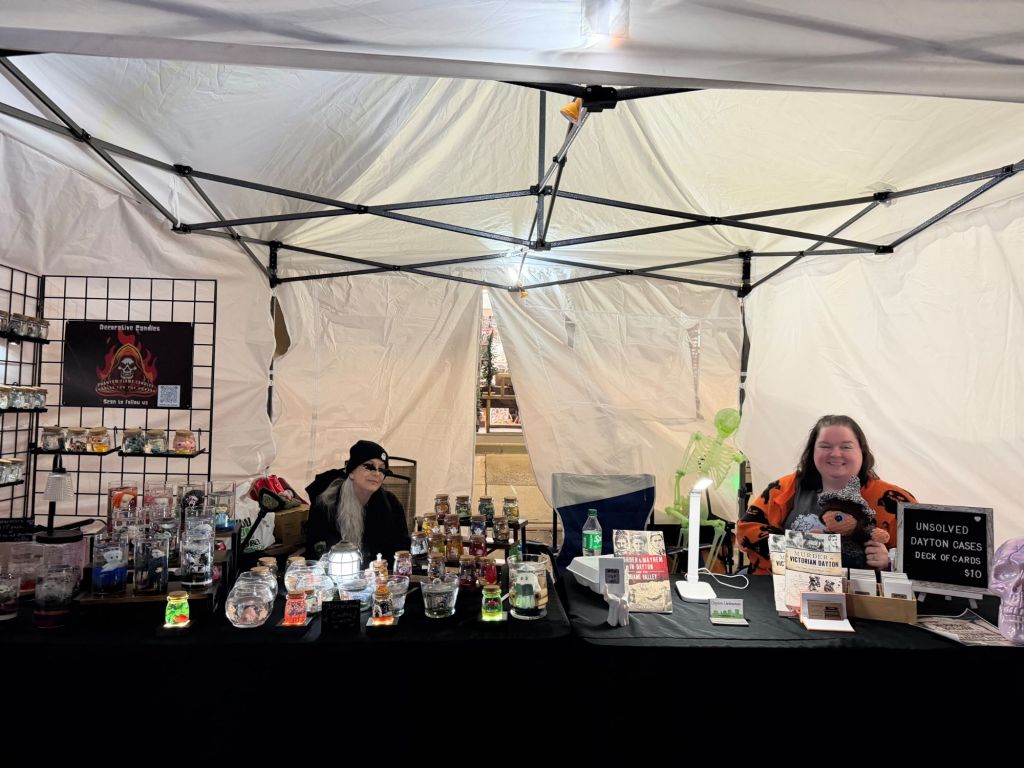

She’s in front of The Secret Chamber house of Oddities and Artwork and sharing a booth with Kim from Phantom Flame Candles today from 11am-11pm, and tomorrow from 12pm-6pm!
After the hanging of Harry Adams, the scaffold was dismantled and stored beneath the Montgomery County Jail. It was reconstructed and displayed in 1955, then dismantled and stored by Dayton History. Adams was the last legal hanging in Dayton.
In 1885, Ohio took the responsibility for executions out of county hands since so many hangings were botched. In 1897, Ohio became the second state to use the electric chair for capital punishment, hoping for a more humane method. Daytonian Albert Frantz became the fourth Ohio execution by electric chair. Albert was convicted in 1896 of murdering his girlfriend, Bessie Little.
Just like any other member of the community, Mr Moler relied on and participated in these bees regularly. As a member of the Methodist Episcopal Church, he was a firm opponent to the use of liquor during these bees, even offering 12½ cents more per day to men who would abstain from drink during that time. Eventually, he refused to hire help who used whiskey. His opponents were upset by this and declared they wouldn’t help him.
A stonemason named James Dean from Dayton heard about this and gathered a party to go harvest Moler’s wheat. When neighbors noticed the immaculate job Dean’s party did, they hired them as well to harvest their grain. Dean later found whiskey in one of the neighbor’s homes and promptly led his party back to Dayton, leaving the neighbor’s harvesting unfinished.
Source: Dayton Daily News, February 29, 1936
But remembering is personal.
This year marks 25 years since September 11th, 2001. A quarter of a century has passed, yet for those of us who lived through that day, many of the memories remain remarkably clear. We remember where we were, who we were with, what we saw, what we heard, and the moment we realized something was terribly wrong. Even after all these years, certain details remain fixed in our minds.
Our experiences of September 11th were different, as were the ways we understood what was happening around us. But like millions of Americans, we each carry a story from that day and from the days that followed.
Today, we wanted to share our memories.
Not because our experiences were extraordinary, but because remembering September 11th also means remembering it through the individual lives it touched. These are our memories of September 11th, 2001.
Bethany:
Most of what follows in my memories is just the feelings. Shock, sadness, confusion, fear. We were just 20 minutes from Wright-Patt and there were rumors that the base was a target because it was so important. In the following days, I remember being in the Dollar Tree in Kettering with my mom and sister and one of them heard the sonic boom of a low-flying jet and everyone was terrified.
But mostly, I also remember the unity we all felt. Nobody cared if you were popular, an outcast, a jock, a brain, a theater kid, a marching band kid…we were all just American teenagers. We were all just trying to understand. It seems silly, but one of my clearest memories was that in my Economics class a month or two later, we had to market, produce, and sell something in the cafeteria and because the patriotic sentiment was running so strong at that time, we braided pieces of red, white, and blue bandanas into keychains and sold them. We sold out quickly and won the competition between Economics classes.
Sara:
I watched in horror as footage played of planes hitting the World Trade Center Towers. I was a 15-year-old sophomore watching real people die on TV. In every class after that, we watched the TV for any updates. Our school principal, Dr. McAtee, announced that we need to continue with classes, so we didn’t let the terrorists win, as if drawing Punnett squares in 4th period biology would defeat them.
By the end of the day, rumors had circulated that Wright-Patt Air Force Base was next to be bombed. My dad worked there, and I remember rushing home after I got off the school bus that afternoon so I could call him (cell phones were not common then). I was so relieved to see his car parked out front as I rushed up the street to my house. The base had sent home all non-essential personnel and my dad explained to me that it was restricted air space, so the base would be immediately on defense if any aircraft flew overhead, especially then.
In the days after 9/11, people who never watched the news (including me) came home every day and turned it on. People became patriotic where before they hadn’t been. Lee Greenwood’s song, “God Bless the USA” played on every radio station and on TV specials.
Where were you on 9/11? What do you remember about that day?
The Miami Conservancy District was organized in 1915, in response to the Great Dayton Flood (in 1913). The MCD built levees, straightened the river channel, and built 5 dams to control flooding in the Miami Valley. The Miami Conservancy District was the first major watershed district in the nation. The district and its projects are unusual in that they were funded almost entirely by local tax initiatives.
The small village of Osborn, Ohio had little damage from the flood, but experienced issues from its aftermath. The village was located directly in the path of the new Huffman flood plain. The citizens of Osborn decided not to abandon their home, but instead, decided to move their homes to just outside Fairfield, Ohio. Years later, the two towns merged, and changed their name to Fairborn, Ohio.
The 5 dams built to control flooding are:
The nearest Buc-ee’s is 16 miles from the Beaver’s Mini Mart location in the middle of a city that has been using beaver iconography for decades via school mascots, team logos, business advertisements and more. The small convenience store has no gas pumps, no public bathrooms, and a logo that looks nothing similar.
Many want to help support this small business. Here are a few ways to do so:
Please note, there is a lot of misinformation going around about the ownership of the Beaver’s Mini Mart. We ask that you do your due dilligence and your own research before forming your opinion, or having a negative reaction to their plight.

