On the opening night of February 14th, 1939, the lights went out, which required the crowd to tour their new library by candlelight. To celebrate 80 years of service to the community and commemorate the opening night, Wright Library held a candlelight celebration with historical items on display and a telling of the story of opening night.
It’s Our 5th Anniversary!
Since then…
170 Posts
52,095 Views
750 Followers on WordPress
387 Posts on Instagram
2,414 Followers on Instagram
288 Likes on Facebook
So many wonderful people met.
And an unquantifiable amount of facts learned about Dayton.
Here are a few highlights of the past five years:
- Most Popular Story: Hills and Dales Lookout Tower: The REAL Story
- Sara’s Favorite Story: The Sad Tale of James Murphy
- Bethany’s Favorite Story : Going Out with a Bang: My God, I’ve Shot Myself
- Two stories in the Dayton Daily News:
- Four Events Planned and Hosted:
- Dayton Unknown Riverwalk
- Dayton Unknown Summer Scavenger Hunt
- Dayton Unknown Fall Scavenger Hunt 2014
- Dayton Unknown Fall Scavenger Hunt 2016
We are so excited to see what the future holds for us!
As always, if you have any story ideas or questions you’d like us to look into, please let us know! There are so many ways to contact us – leave a comment down below, via the Contact Us page, send an email (daytonunknown@hotmail.com), send a message on Facebook or Instagram (@daytonunknown), etc..
Some Interesting Street Names
- Shoup Mill Road —Named for the mill on the Stillwater River
- Claggett Drive, Neff Road, Ensley Avenue, and Drill Avenue – named for early settlers of Dayton
- Bidleman Street — Short street named for Chas Bidleman, a Dayton dry goods merchant
- Clay Street —named for Henry Clay, a former candidate for U.S. president
Edwin C. Moses
“Lots of people let it go by and never accomplish what they want. I just wanted to see what I could do.” – Edwin C. Moses
Edwin Corley Moses was born in 1955 in Dayton, Ohio. As the son of two educators, Edwin took academics seriously. In addition to being an excellent student, he was also a gifted athlete.
During high school, Edwin participated briefly in basketball and football, but soon turned to Track and Field. Edwin accepted an academic scholarship to Morehouse College, majoring in Physics and Industrial Engineering. Morehouse College did not have its own track, so Edwin practiced on nearby high school tracks. He competed mostly in 120-yard hurdles and the 440-yard dash. Edwin attributed his success at running to applying his knowledge of the mechanics of running and lots of stretching. He had a trademark technique, taking a consistent 13 steps between each hurdle instead of the usual 14, causing him to get ahead in the 2nd half of the race as his competitors changed their strides.
Dayton Sights: Places of Worship
Waldruhe Park
Waldruhe Park was a gift to the city from Adam Schantz Jr., and is a gorgeous park saturated with trees. “Waldruhe” is German for “quiet forest.”
Adam Schantz, Jr.
Adam Schantz, Jr. was born December 16, 1867 on River Street in Dayton, Ohio. Son of Adam Schantz, Sr. and Salome Schantz, he joined his father in the meat-packing industry at the age of twelve. Later on, he became the bookkeeper for the brewery run by his father and uncle. Once he turned twenty-one, he controlled almost all of his father’s interests.
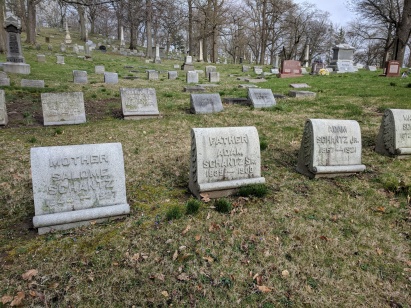
After Adam Sr. died, Adam Jr. became executor of the Schantz Estate. Adam Jr. was recognized as having made more changes to the Dayton skyline than anyone else. Ludlow Street was virtually rebuilt by him.
Glen Helen: Inman Trail
While there are SO many great things to see in Yellow Springs, we are focusing on a few of the better known places along the Inman Trailtrail map at the Glen Helen Nature Preserve. Inman Trail is a 1.1 mile hike, commonly hiked by couples, families, photographers, and their four-footed friends.
Pompey’s Pillar
A natural rock formation created from glaciers freezing and thawing, this large pile of rocks split from the cliff above and made its way slowly down to where it is now. Although some people have marred it with graffiti (seriously, people?) this formation is an awesome sight along the trail.

The Yellow Spring
A spring is defined as water overflowing from an aquifer. In this particular spring, the water underground is clear, but turns yellow when it hits the air. The iron in the water becomes rust when exposed to air, and turns into the well-known yellowish orange color that gave Yellow Springs its name. Experts theorize the water may run through an iron deposit underground (called a vugg) or the geology of the area could just contain excess iron.
Liberty Tower
After the flood of 1913, Second Street faced a new frontier. As it had previously been occupied by mansions and apartment buildings, the flood pushed residents away from downtown, moving them to Salem Avenue and Far Hills Avenue. This created the prime opportunity for development.
Planning for the Liberty Tower started in 1929, and construction started the next year. It took 11 months to create what was Dayton’s tallest building at that time. Liberty Tower was the tallest building in Dayton from 1931 until the construction of the Kettering Tower in 1969. The Mutual Home Building, as it was known then, was built out of concrete and steel and 23 stories tall. Attendants manned the garages and state-of-the-art elevators, giving an air of elegance.

