Dayton Hero – David T. Chambers

The chain of events that started Dayton’s Great Flood started on March 21, 1913, with a rainstorm. Over the next few days, more rain came, ultimately weakening the levees and flooding the already oversaturated soil. Water rose quickly, and as gas lines were destroyed, a fire started downtown that destroyed most of a block.

As these events were happening, twenty four year old David T. Chambers of North Dayton could not stand by and watch without helping. From the safety of his home, which was located above the flood waters, he could see the damage being caused by the rising waters.

Continue reading

Dayton Firsts Part 4

It’s that time again! Let’s find out more about the early years of Dayton!

First Library — The first library association (also the first in the state of Ohio) was formed on February 1, 1805, through an act of the legislature. Rev. William Robinson served as the first president of the organization.

First Graveyard — Next to the Presbyterian church at the corner of Third Street and Main Street. In 1805, Daniel Cooper gave four acres of land between Ludlow Street and Wilkinson Street to form a cemetery shared by the Presbyterians and Methodists.

Continue reading

Bess Little

By all accounts, Bessie Little lived a life full of ups and downs. Born as Tressie Doty and orphaned, she was adopted at the age of two by Peter and Elizabeth Little from the Miami County Infirmary in Troy.

She was known to be a sweet girl, studious and kind. She was a regular at her church, and a beauty to everyone who knew her, including Albert Franz.

Continue reading

Lib Hedges

Everyone knew about Pearl Street in Dayton’s Red Light District, but nobody admitted so.

“Most of the houses were ornately trimmed; each had the name of the proprietor, a single woman posted in the door glass or permanently etched there, and at night, in the window on a table sat a red lamp, spreading its cheery invitation to all.  Within the houses many women followed a profession dignified only by its extreme age.”

Continue reading

Woodland Cemetery Series: Matilda Stanley – Queen of the Gypsies

Matilda Stanley holds records. She holds one record for being the person held in Woodland’s receiving vault the longest, one for being the most loved Gypsy queen recorded, and also the only known gypsy funeral to be presided over by an “outsider”, Reverend David Berger. At an estimated 15-25k people, Matilda’s funeral is also the biggest one to have been seen in Dayton.

Matilda married her husband Levi in Berkshire, England and together with their families, moved to the United States in 1856. They chose Dayton as their summer headquarters, heading south every winter to live in warmer weather, the procession down Main street a spectacle.

Because record keeping was not very stringent, Matilda’s exact date of birth can only be guessed as sometime in 1821. Her date of death is more concrete, confirmed as January 15, 1878. Woodland held her body in the receiving vault until September of that year, in order to give friends and family time to travel from all over the world to attend her funeral.

Continue reading

Calvary Cemetery

Although predominately a Roman Catholic cemetery, all faiths are welcome at Calvary Cemetery. Currently it is the final resting place for roughly 75,000 people including 6,000 people exhumed and moved from the former St. Henry’s Catholic Cemetery, which was located at Main Street and Third Street.

20140701_163533

Continue reading

Fun Facts about Dayton – Part 3

Here’s some more fun facts about Dayton we’ve learned during our research:

  •  The Private Fair statue on Main Street just south of Monument Avenue in downtown was almost a statue of the Goddess of Liberty, but ex-Civil War soldiers protested, and requested the goddess instead be a statue of a soldier. Private George Washington Fair of Dayton was the model for the statue, which was erected in 1884 – the original location at the intersection of Main and Monument.
  • The statue of President McKinley in Cooper Park (behind the Dayton Library on Third Street and St. Clair) was built from funds raised and donated by local schoolchildren.
  • Continue reading

David’s Cemetery

Located at the corners of Mad River Road and David Road in Kettering, David’s Cemetery is one of the older cemeteries in the Dayton area. The cemetery was formed on land donated by local man, Christian Creager, in 1826 and recognized its first burial in 1831 — a young boy named Noah Darner. It was named after Rev. David Winters, the first preacher to serve the Dayton area.

DavidsCemeteryCollage

Continue reading

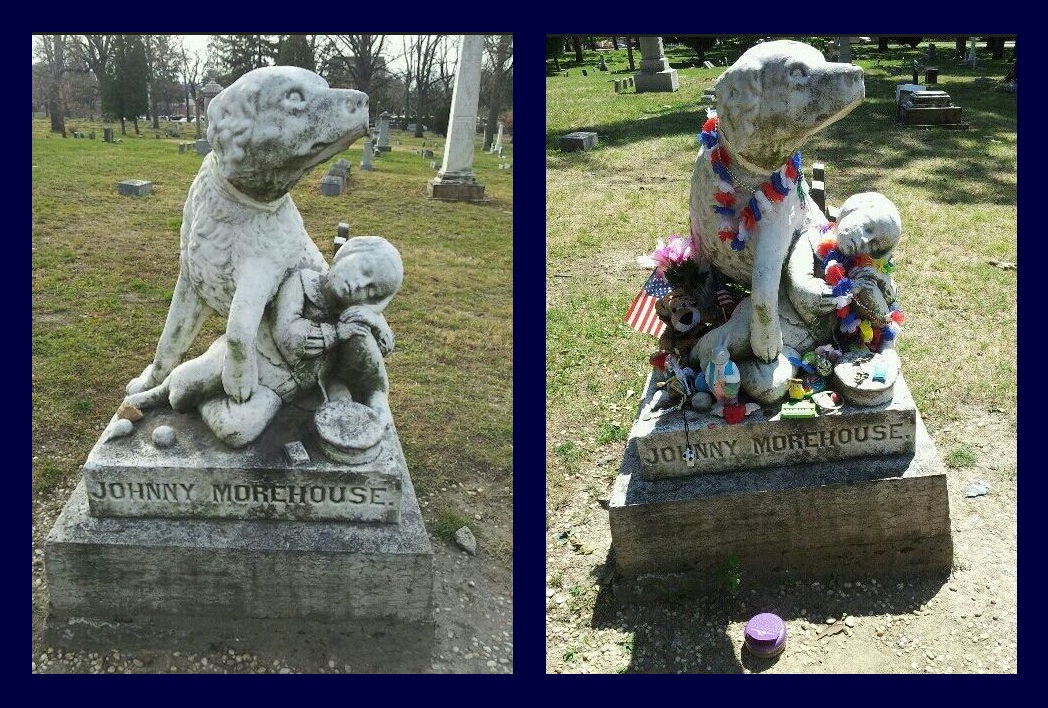
Woodland Cemetery Series: The Boy and His Dog

JohnnyMorehouse

Johnny Morehouse is perhaps one of the most famous graves in Woodland Cemetery. Johnny drowned in the mid 1800s, and there are many stories about his dog’s death.

One story is that Johnny’s dog jumped in the river and drowned trying to save him. The family was so moved by his loyalty to the boy that they had the grave marker sculpted of him and Johnny.

Continue reading