A spring is defined as water overflowing from an aquifer. In this particular spring, the water underground is clear, but turns yellow when it hits the air. The iron in the water becomes rust when exposed to air, and turns into the well-known yellowish orange color that gave Yellow Springs its name. Experts theorize the water may run through an iron deposit underground (called a vugg) or the geology of the area could just contain excess iron.
Liberty Tower
After the flood of 1913, Second Street faced a new frontier. As it had previously been occupied by mansions and apartment buildings, the flood pushed residents away from downtown, moving them to Salem Avenue and Far Hills Avenue. This created the prime opportunity for development.
Planning for the Liberty Tower started in 1929, and construction started the next year. It took 11 months to create what was Dayton’s tallest building at that time. Liberty Tower was the tallest building in Dayton from 1931 until the construction of the Kettering Tower in 1969. The Mutual Home Building, as it was known then, was built out of concrete and steel and 23 stories tall. Attendants manned the garages and state-of-the-art elevators, giving an air of elegance.
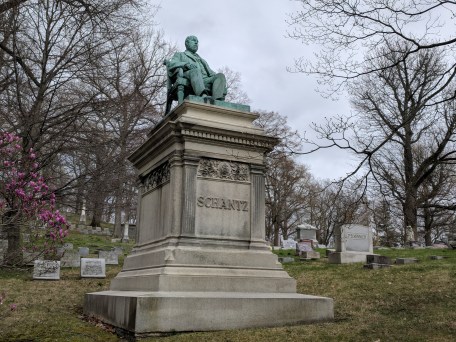
Adam Schantz, Sr.
But who is he?
Interesting Street Names
- Cline Street – Once known as Zigzag Street because it ran along an open ditch, called Seely’s ditch, but has long since been straightened.
- Hoover Avenue – Not named for the president, but for local residents and the Hoover Park plat developed in 1917.
- Demphle Avenue – named for Sebastion Demphle, a local stove dealer.
- Babbitt Street – A T.S. Babbitt lived at First Street and Bridge Street, later Stratford Lane.
- Kiefaber Street – named after Warner Harshman Kiefaber Sr, who graduated from St Mary’s Institute class of 1905 and later founded the W.H Kiefaber Company on Keowee Street and Monument Avenue in 1920.
Water you doing, Dayton?
Before Holly Water, residents drank well water, benefiting from the filtering effects of the porous sub-soil. By the 1860s as more and more people moved into Dayton, those water sources became compromised, with an increasing amount of cesspools infringing on the borders of these wells. This led to the first Board of Health being created in 1868. A Committee was formed to address the issues, ultimately choosing the “Holly System.”
Sideshow 13
45th Annual A World A’fair
To the lady who met Bethany’s mother at the base hospital yesterday: we would love to know who you are, and we thank you for your kind words!
Gem City Made Craft Show
This year was only the second year for Gem City Made, but Beavercreek Nazarene has been holding a Holiday Bazaar every November for over 25 years! We’ll make sure to post details about the Holiday Bazaar before the event in early November.
During the event, we made sure to visit every booth, and we saw a few familiar faces, but met a lot of great new vendors.
Street Art becomes a Legacy

Back in September 2016, Bethany made a seemingly random decision to take a different route home from work. During that trip, she happened to spot an artist working on a mural on the side of Keowee Street. She turned around and pulled over, and had the pleasure of meeting the artist, Nick Edwards, and he let her take this picture and feature it on Dayton Unknown’s Instagram. We didn’t really know him, but we loved seeing his artwork around town.
Rest in Peace, Nick, and our condolences to all who loved you.

Lee Lynam
Note: In honor of Peace Officers Memorial Day on May 15th, we decided to share a story about one of Dayton’s own Peace Officers.
January 17, 1880 was a normal day on the beat for Patrolman Lee Lynam. That morning, he arrested a man named John Francis on suspicion of having a gun. Francis was later released and told to “behave.”
But behave, he did not.