Edwin C. Moses

Lots of people let it go by and never accomplish what they want. I just wanted to see what I could do.” – Edwin C. Moses

Edwin Corley Moses was born in 1955 in Dayton, Ohio. As the son of two educators, Edwin took academics seriously. In addition to being an excellent student, he was also a gifted athlete.

During high school, Edwin participated briefly in basketball and football, but soon turned to Track and Field. Edwin accepted an academic scholarship to Morehouse College, majoring in Physics and Industrial Engineering. Morehouse College did not have its own track, so Edwin practiced on nearby high school tracks. He competed mostly in 120-yard hurdles and the 440-yard dash. Edwin attributed his success at running to applying his knowledge of the mechanics of running and lots of stretching. He had a trademark technique, taking a consistent 13 steps between each hurdle instead of the usual 14, causing him to get ahead in the 2nd half of the race as his competitors changed their strides.

Continue reading

Dayton Sights: Places of Worship

When I think of a place of worship, I think of a place where one can sit and be reminded of all the things that are important outside our individual lives. To express spirituality, the architect has to think of the original material of architecture, space and light.” – Richard Meier

This slideshow requires JavaScript.

Plant Nite Dayton

We got to attend the first Plant Nite event in Dayton on August 20th. Similar to the wine and paint events, at Plant Nite, you get step-by-step instructions on how to create terrariums and other tabletop gardens while enjoying the venue of the evening – typically a bar or restaurant.

Continue reading

Trains & Trolleys

The first street car line in Dayton was built by the Dayton Street Railway Company, which was chartered in 1869 with John V. Kreidler as the first superintendent.The line extended from the land of W.P. Huffman on East Third Street, to the land of H.S. Williams on West Third Street. One hour and 20 minutes was required to make the round trip from Western Avenue to Findlay Street.

DSR Trolley Train

Continue reading

Andrew Walsh & Lost Dayton, Ohio

Writer, Dayton Historian, Librarian…Andrew Walsh can add one more title to his resume: published author. In his book, Lost Dayton, Ohio, Andrew covers many historical Dayton structures lost to time and urban renewal and revitalization efforts.

IMG_20180801_203446

A transplant to Dayton in 2013 from Wisconsin, Andrew became interested in the historical architecture of Dayton as he viewed Dayton from his window at Dayton Towers. Although Andrew no longer lives there, his fascination continues.

Continue reading

Adam Schantz, Jr.

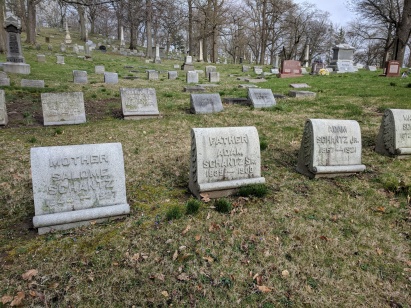
Adam Schantz, Jr. was born December 16, 1867 on River Street in Dayton, Ohio. Son of Adam Schantz, Sr. and Salome Schantz, he joined his father in the meat-packing industry at the age of twelve. Later on, he became the bookkeeper for the brewery run by his father and uncle. Once he turned twenty-one, he controlled almost all of his father’s interests.

IMG_20180416_173942

After Adam Sr. died, Adam Jr. became executor of the Schantz Estate. Adam Jr. was recognized as having made more changes to the Dayton skyline than anyone else. Ludlow Street was virtually rebuilt by him.

Continue reading

Glen Helen: Inman Trail

While there are SO many great things to see in Yellow Springs, we are focusing on a few of the better known places along the Inman Trailtrail map at the Glen Helen Nature Preserve. Inman Trail is a 1.1 mile hike, commonly hiked by couples, families, photographers, and their four-footed friends.

Pompey’s Pillar
A natural rock formation created from glaciers freezing and thawing, this large pile of rocks split from the cliff above and made its way slowly down to where it is now. Although some people have marred it with graffiti (seriously, people?) this formation is an awesome sight along the trail.

IMG_20180120_121817

Continue reading

The Yellow Spring

What exactly causes the Yellow Spring to be yellow? In a nutshell, iron.

A spring is defined as water overflowing from an aquifer. In this particular spring, the water underground is clear, but turns yellow when it hits the air. The iron in the water becomes rust when exposed to air, and turns into the well-known yellowish orange color that gave Yellow Springs its name. Experts theorize the water may run through an iron deposit underground (called a vugg) or the geology of the area could just contain excess iron.

Continue reading