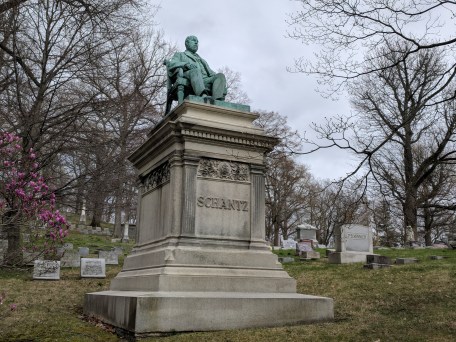
Adam Schantz, Sr.
But who is he?
Interesting Street Names
- Cline Street – Once known as Zigzag Street because it ran along an open ditch, called Seely’s ditch, but has long since been straightened.
- Hoover Avenue – Not named for the president, but for local residents and the Hoover Park plat developed in 1917.
- Demphle Avenue – named for Sebastion Demphle, a local stove dealer.
- Babbitt Street – A T.S. Babbitt lived at First Street and Bridge Street, later Stratford Lane.
- Kiefaber Street – named after Warner Harshman Kiefaber Sr, who graduated from St Mary’s Institute class of 1905 and later founded the W.H Kiefaber Company on Keowee Street and Monument Avenue in 1920.
Dayton Firsts Part 12
- First Telegraph Message – Received in Dayton on September 17, 1847.
- First United Brethren Church – The first United Brethren church in Dayton was organized in 1847, in a small room in the Oregon Engine House. Their first church building was erected in 1852, at Sixth Street and Logan Street, later being purchased by the city and converted into a city prison.
- First Gas Company – Chartered February 4, 1848, by Daniel Beckel, Peter Voorhees, Daniel Stout, I.F. Howells, David Winter, J.D. Loomis, J.D. Phillips, Valentine Winters, John Mills and Daniel W. Weelock.
- First Hebrew congregation – The first Hebrew congregation was organized in 1850. They met in the old Dayton Bank building until 1863, when they purchased the old Baptist house of worship.
221 Years Ago, Tomorrow
“The boat party was the first to arrive. Rounding the curve in the river, where for so many years since then it has been flowing under the Dayton View bridge, the pioneers perceived before their eyes the swift current of Mad River emptying itself into the main channel, just as it had been described, and saying to each other (so we may imagine), ‘Yes, this must be the place,’ they tied the pirogue to a tree at the head of St. Clair Street and led by Mrs. Thompson, all clambered ashore.
At that moment DAYTON came on the map!”
– Charlotte Reeve Conover, The Story of Dayton.
Two hundred and twenty-one years ago tomorrow, Dayton was founded. To honor this occasion, we decided to share some of our favorite pictures we’ve taken around Dayton.
Also, please send us your favorite picture you’ve taken around Dayton, and we’ll feature it in a future blog post! You can send it to our email at daytonunknown@hotmail.com – and be sure to provide your name for photo credit!
David’s Cemetery Notable Burials
Dayton Firsts Part 10
- First Canal boat – The first canal boat built in Dayton was christened the Alpha and was launched on Saturday, August 16, 1828, at 2 p.m. The first canal boat to arrive in Dayton with the formal opening of the canal was the General Brown. It arrived at the landing near the present site of the main branch of the Dayton Metro Library on January 26, 1829.
- First Mayor – In 1829 a new charter went into effect in Dayton. Under it, the chief executive of the city became referred to as the Mayor, instead of the President of Council. Under the new charter John Folkerth was made the first Mayor of Dayton.
Local Street Names Part 6
Curious about the early roads of Dayton, and their namesakes?
- The following streets were named after the towns they went to: Troy, Bellefontaine, Wilmington, Belpre, Germantown, Xenia, and Salem (later changed to Clayton).
- King – William King, an early settler of Dayton.
Dayton Fun Facts Part 1
Occasionally in our research, we come across a really interesting fact, but there isn’t enough for a full story. We like to compile these into lists to share. Here are a few!
- Mad River, the former Wayne Township (now Huber Heights), Wayne High School, and Wayne Avenue are all named for Major General “Mad” Anthony Wayne.
- Abraham Lincoln credits the first mention of his presidential race to Dayton, Ohio.
- On March 30, 1901, the Dayton Daily News was run by a women-only editorial staff. Local historian Charlotte Reeve Conover approached James M. Cox and asked him to allow the Young Women’s League to run the paper for one day to raise money for a new building. Despite predictions of failure, the paper not only went to press on time, but the demand was so high, they had to work overtime to compensate. The ladies received a check for $1,800 for their efforts.
Dayton Firsts Part 8
- First Girls’ School – Opened in March, 1815, by Mrs. Diomecia Sullivan on the west side of Main Street, south of Third Street.
- First Show – A display of “wax works and figures,” on February 13, 1815.
- First Fire Engine – Came from Philadelphia and through Cincinnati, and arrived in Dayton in the spring of 1826.
- First Milliner – The first millinery store was opened by Ann Yamans in June 1815. She advertised her supply of goose feathers, and announced that military gentlemen could find her shop on Main Street, south of Second Street, with a full stock of plumes and decorations.
 Dayton Unknown