Waldruhe Park
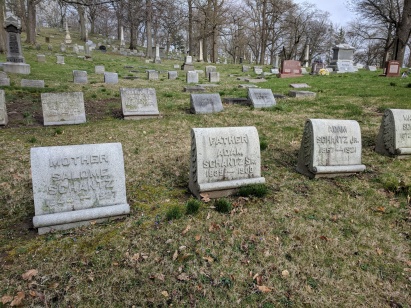
Waldruhe Park was a gift to the city from Adam Schantz Jr., and is a gorgeous park saturated with trees. “Waldruhe” is German for “quiet forest.”
Trains & Trolleys

Andrew Walsh & Lost Dayton, Ohio
Writer, Dayton Historian, Librarian…Andrew Walsh can add one more title to his resume: published author. In his book, Lost Dayton, Ohio, Andrew covers many historical Dayton structures lost to time and urban renewal and revitalization efforts.

A transplant to Dayton in 2013 from Wisconsin, Andrew became interested in the historical architecture of Dayton as he viewed Dayton from his window at Dayton Towers. Although Andrew no longer lives there, his fascination continues.
Adam Schantz, Jr.
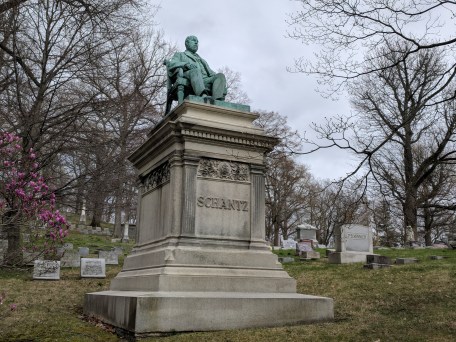
Adam Schantz, Jr. was born December 16, 1867 on River Street in Dayton, Ohio. Son of Adam Schantz, Sr. and Salome Schantz, he joined his father in the meat-packing industry at the age of twelve. Later on, he became the bookkeeper for the brewery run by his father and uncle. Once he turned twenty-one, he controlled almost all of his father’s interests.
After Adam Sr. died, Adam Jr. became executor of the Schantz Estate. Adam Jr. was recognized as having made more changes to the Dayton skyline than anyone else. Ludlow Street was virtually rebuilt by him.
Liberty Tower
After the flood of 1913, Second Street faced a new frontier. As it had previously been occupied by mansions and apartment buildings, the flood pushed residents away from downtown, moving them to Salem Avenue and Far Hills Avenue. This created the prime opportunity for development.
Planning for the Liberty Tower started in 1929, and construction started the next year. It took 11 months to create what was Dayton’s tallest building at that time. Liberty Tower was the tallest building in Dayton from 1931 until the construction of the Kettering Tower in 1969. The Mutual Home Building, as it was known then, was built out of concrete and steel and 23 stories tall. Attendants manned the garages and state-of-the-art elevators, giving an air of elegance.
Adam Schantz, Sr.
But who is he?
Interesting Street Names
- Cline Street – Once known as Zigzag Street because it ran along an open ditch, called Seely’s ditch, but has long since been straightened.
- Hoover Avenue – Not named for the president, but for local residents and the Hoover Park plat developed in 1917.
- Demphle Avenue – named for Sebastion Demphle, a local stove dealer.
- Babbitt Street – A T.S. Babbitt lived at First Street and Bridge Street, later Stratford Lane.
- Kiefaber Street – named after Warner Harshman Kiefaber Sr, who graduated from St Mary’s Institute class of 1905 and later founded the W.H Kiefaber Company on Keowee Street and Monument Avenue in 1920.
Water you doing, Dayton?
Before Holly Water, residents drank well water, benefiting from the filtering effects of the porous sub-soil. By the 1860s as more and more people moved into Dayton, those water sources became compromised, with an increasing amount of cesspools infringing on the borders of these wells. This led to the first Board of Health being created in 1868. A Committee was formed to address the issues, ultimately choosing the “Holly System.”
45th Annual A World A’fair
To the lady who met Bethany’s mother at the base hospital yesterday: we would love to know who you are, and we thank you for your kind words!

