
Desch and his team worked in one of NCR’s buildings decoding the messages using the American Bombe Machine and would then send the messages to Washington D.C. as intelligence. While working with the American Bombe Machine, Alan Turing – known for cracking Germany’s Enigma code – visited Joseph Desch in Oakwood and at the NCR building.
Retired RAF Captain Andrew Lloyd, along with the organization he founded, Oakwood Unsung Heroes, have been working to showcase this piece of history by having a City of Oakwood proclamation for the month of May to be Codebreaker Month, and they have an exhibit on display at Wright Memorial Public Library in collaboration with the National Cryptologic Museum.
On May 8th, the nephew of Alan Turing, Sir Dermot Turing, will be speaking at the Dayton International Peace Museum and at Carillon Park. For both events, tickets are free, but limited.
- May 8th at 11am @ Dayton International Peace Museum
- May 8th at 7:30pm @ Carillon Park
If you’re interested in reading more about this topic:
- X, Y & Z by Sir Dermot Turing
- The Codebreakers of Bletchley Park: The Secret Intelligence Station that Helped Defeat the Nazis by Sir Dermot Turing
- The Enigma Story: The Truth Behind the ‘Unbreakable’ World War II Cipher by Sir Dermot Turing
- Reflections of Alan Turing: A Relative Story by Sir Dermot Turing
- The Secret in Building 26: The Untold Story of America’s Ultra War Against the U-boat Enigma Codes by Jim Debrosse
The Lady Be Good
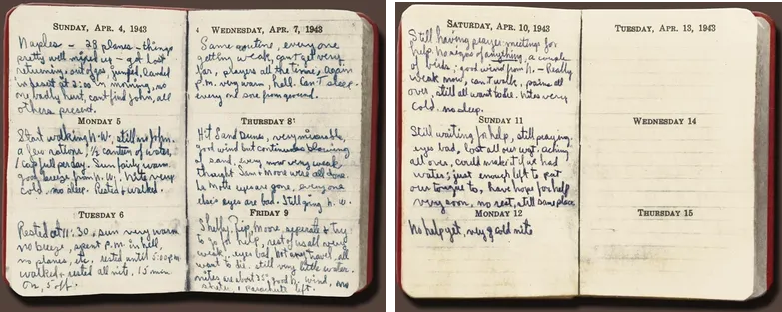
Excepts from co-pilot Robert F. Toner’s journal. Source: Lady Be Good.net
A long search for the remains returned eight of the nine crew members. One was located near the plane and seven were far north of the plane. Five of the crew had walked 78 miles before succumbing to the desert and one man had gone 109 miles. Additionally, the men had lived for eight days, which was miraculously longer than the two day survival expectation of men in those conditions. No trace of the ninth man was ever found.
Continue reading
Lieutenant Colonel Charity Adams Earley
Charity Edna Adams was born in Kitrell, North Carolina in 1918. Her father was a minister, and her mother was a former teacher. When she was a young girl, her family moved to South Carolina, which she later considered home.
Charity was intellectually gifted and started school in second grade. By the end of elementary school, she was tested and scored ready to start high school. Her parents decided not to advance her any more grades since she was already a few grades ahead of her age group in school. Charity graduated school two years early as valedictorian. At Wilberforce College, Charity majored in Latin, Math, and Physics. She held a part-time job and was involved in many student activities before she graduated in 1938.
During WWII, Charity was the first African American female officer in the Women’s Auxiliary Army Corps (WAAC, later called WAC). She led the 3rd Training Regiment, made up of two white and one black platoon. At Fort Des Moines, she was promoted to Major, which made her the highest-ranking female officer at the fort and one of the highest-ranking WAC officers in the country. She then deployed to Europe and led the first Black WAC unit to serve overseas. For her work in Europe, Charity was promoted to Lieutenant Colonel, the highest possible rank for WAC.
Continue reading
E.E. Alderman & His Postcards
E. E. Alderman, a Daytonian interested in short wave reception, relayed thousands of messages to families during WWII. Families received news of whether their loved ones had died, were prisoners, or were coming home. By doing this for the Dayton community, it is estimated that he relayed messages to over 9,000 families.
As a result of this, one of our readers reached out to us to share two postcards that E.E. Alderman sent about his grandfather, Private G.M. Brown.
The first postcard, dated December 12, 1944, was addressed to the postmaster of Canandaigua, New York to notify the kin of Brown’s capture by the Germans.


The second post card was to Brown’s sister Doris, dated December 22, 1944. This message thanked her for her contribution to Alderman’s endeavors and notifying her that her brother was safe and well, although still a Prisoner of War.
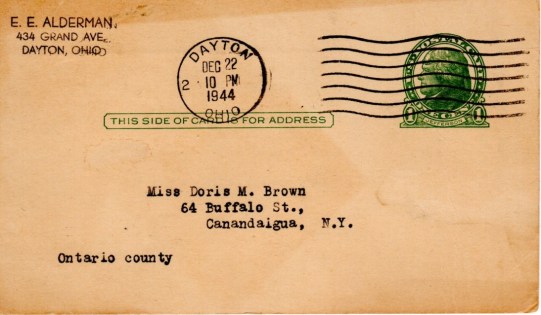
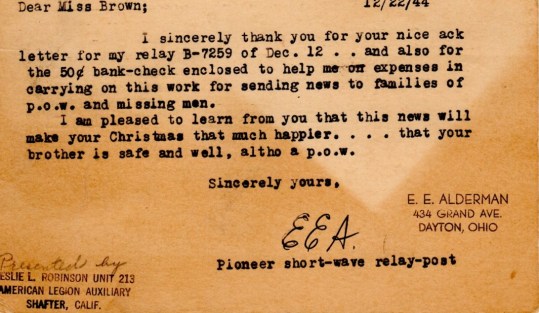
Our reader, Pete Granger, has donated these postcards and many other documents related to his grandfather’s service to the National Infantry Museum & Soldier Center.
The Kettering Bug – The World’s First Drone
Launched using a dolly-and-track system (similar to how the first flight was launched), the Bug was capable of striking targets up to 75 miles away and could travel at speeds of 50 miles per hour. The Bug consisted of an engine, fuselage, and wings and cost about $400 each to produce. The fuselage was made out of papier-mache and wood laminates, and the wings were built out of cardboard. The Bug also had a small onboard gyroscope to guide the Bug to its target.
Continue reading
The 100th Birthday of MSgt. Richard Gard
Master Sergeant Gard landed on Normandy on D-Day and participated in the breakout from the beachhead through France to Brest. Gard was awarded the Silver Star for gallantry in action during the Battle of the Bulge. He also earned two Bronze Stars, a Purple Heart, and decorations from Bastogne, Belgium, and France.
After Master Sergeant was recalled to active duty for the Korean War in 1950, he earned a degree in Engineering from UD.
A parade in his honor will be held on April 6, starting on Pearhill Drive in West Carrollton. The parade will feature Centerville VFW Post 9550, West Carrollton Police and Fire departments, the Montgomery County Sheriff’s Office, Harold Schnell Elementary, West Carrollton Marching Band, and a flyover from a 1943 PT-19A Cornell warplane by the Butler County Warbirds.
To wish Master Sergeant Gard a happy birthday, please send cards to this address:
MSgt. Richard Gard
c/o 70 Pine Street
Franklin, Ohio 45005.
For more of MSgt Gard’s story, check out this story by Dayton Daily News!
Eddie Breen
Eddie Breen served as Mayor of Dayton from 1946-1948 then served as a member of the US House of Representatives from Ohio’s 3rd District.
Eddie had many notable members of his family, including:
- John Breen, who along with John Ohmer had invented and manufactured the Taxi Meter. They originally planned to take the maiden voyage of the Titanic but opted instead to continue their sales trip in Europe.
- Maurice Breen, who smuggled runaway slaves in his wagon among parts for railway construction.
- Bernadina Focke and her sons, who set up a card table in the Arcade selling meat. This business would become a successful meat packing business that lasted until 1972.
- Mary Lousie Breen, who spied for FDR in France and Germany during WWII.
- Marie Berno Focke, who sang and danced with Fred Astaire in the 1920s.
Eddie Breen died on May 8, 1991, and is buried at Calvary Cemetery. For more information about these events and more stories about this family, check out the book Lucky Eddie, by Edward Focke Breen.
Ida Weller
In 1893, At the age of 17, Ida graduated from the Washington Township High School on West Franklin Street. The building still stands today, and until recently, was the Las Piramides Mexican restaurant. Two years later at the age of 19, Ida earned her teaching certificate from Ohio Northern College and from 1895-1897, Ida taught at Schoolhouse Number 8, which was located at McEwen Road and State Route 725.
Continue reading
More Fun Dayton Facts
- In 1920, Dayton had no unsolved murders.
- During WWII, Lieutenant Harry Zavakos was reported MIA and presumed dead after his plane was shot down over China. He was actually found by the Chinese and slowly moved across the country to be returned to his unit. During the time the Chinese transported Zavakos, they continually fed him fried chicken.
- Flight personnel gave Dayton the moniker “The Popcorn City” due to the popcorn sold at Wileswood Country Store. Some ground crews would refuse to work on aircrafts if the flight crews did not return from a trip to Dayton with “Dayton popcorn.”
- In 1979, while excavating for the Gem Savings headquarters, the skeleton of an adult male was discovered. The site was originally the location of Dayton’s first cemetery. Since the bodies had never been moved from the location, one theory is that this particular skeleton was John Davis, an early Dayton pioneer.
- Dayton’s most successful professional sports team was the Dayton Gems, a hockey team that played in Dayton from 1964 to 1977.
- Electricity was introduced in Dayton in 1882, when the first electric light turned on in the Dayton Morning Journal office.
- Ponderosa Steakhouse, which was founded in Indiana, moved its headquarters to Dayton in 1968, where it flourished for decades.
- During WWII, there was such a drastic labor shortage in Dayton, that a job draft was considered to fill the positions.
 Dayton Unknown