A Glimpse of Dayton in the Early 1800s

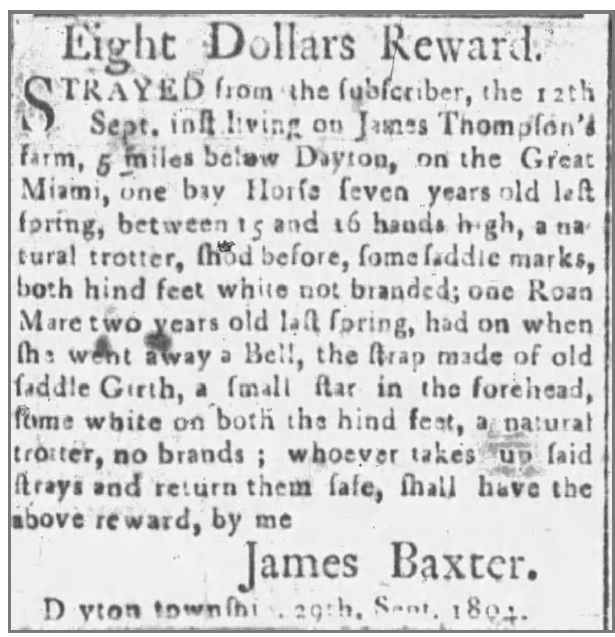
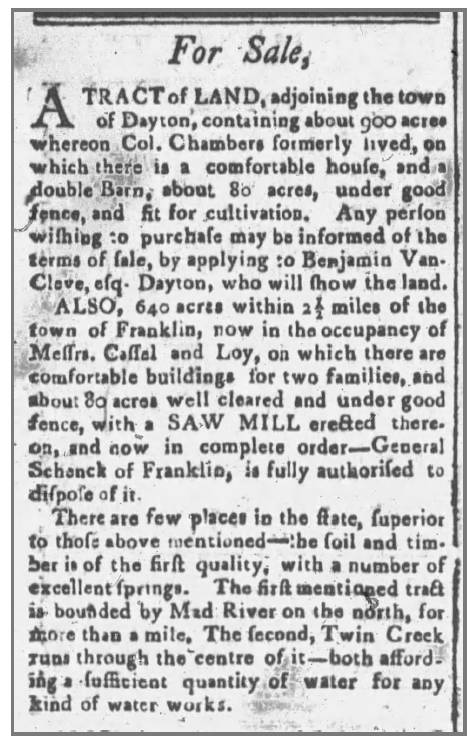
Sometimes in our research, we find some interesting tidbits that aren’t enough for a full story, but we would like to share. Here are three articles from the early 1800s that give a glimpse of life back then. Two missing horses, and a tract of land for sale.

Published in the Western Spy and Miami Gazette (Cincinnati, Ohio) on October 10, 1804.

Published in the Western Spy and Miami Gazette (Cincinnati, Ohio) on December 25, 1805.

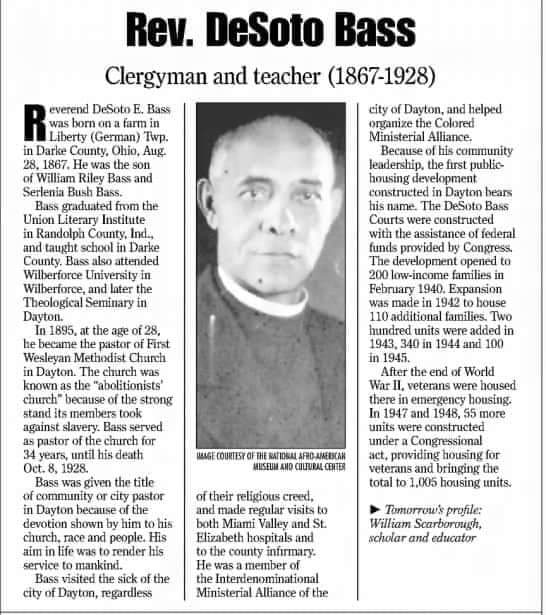
Published in the Western Spy and Miami Gazette (Cincinnati, Ohio) on February 1, 1808.

It’s Our 9th Anniversary!

On January 27th, 2014, Dayton Unknown shared our very first post. Since then…

Most Popular Story: Hills and Dales Lookout Tower: The REAL Story
Sara’s Favorite Story: The Chinese Tong Murder
Bethany’s Favorite Story: General Richard Montgomery

We are so excited to see what the future holds for us!

As always, if you have any story ideas or questions you’d like us to look into, please let us know! There are so many ways to contact us – leave a comment down below, via the Contact Us page, send an email (daytonunknown@hotmail.com), send a message on Facebook or Instagram (@daytonunknown), etc.

More Street and Bridge Honorary Designations

This list is thanks to the book Hidden History by Tony Kroeger, with a small amount of Googling on our part.

  • Chuck Whalen Lane (L Street) – Whalen was a UD graduate who went on to serve as a US Representative
  • Local 696 Way (Alwildy Drive) – United Auto Workers Local 696 has an HQ building on Alwildy, which was designated by Paul Deneau in 1965.
  • Bishop John H. Mathews Jr. Way (College Street) – Mathews was a pastor of Mount Zion Church.
  • Keith A Byars Sr. Way (Hoover Avenue) – Byars is a Dayton native who played in the NFL for 13 seasons as fullback and tight end. He played seven seasons for the Eagles, made the Pro Bowl in 1993 with the Dolphins, then SuperBowl XXXI with the New England Patriots.
  • Commissioner Richard a Zimmer Memorial Bridge (Findlay Street Bridge) – Zimmer was a Dayton City Commissioner for 21 years.
  • Dean Lovelace Drive (Madden Hills) – Lovelace was a Dayton City Commissioner.
  • Martin Bayless Drive (Enroe Drive) – Bayless is a Dayton native who played in the NFL for 13 seasons for: St Louis Cardinals; Buffalo Bills; San Diego Chargers, Kansas City Chiefs, and Washington Redskins. He is now a Director of Player Development and General Manager at Brevard College.

General Richard Montgomery

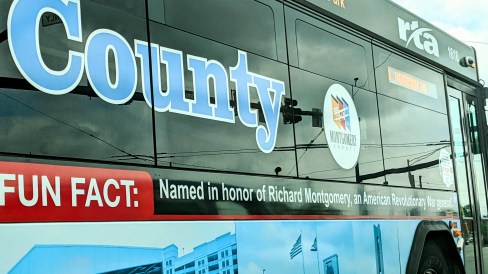
When Sara realized that she had lived here her entire life, and didn’t know who Dayton was named after, she had the idea for Dayton Unknown. Yet it never occurred to us that we didn’t know who Montgomery County is named after until Bethany was at a stoplight one day and read the fun fact printed on the RTA bus next to her.

Street and Bridge Honorary Designations

Perhaps you’ve seen the blue street signs above the regular street signs with names on them. Did you recognize the names? Did you wonder who they were or what they did? Here’s a list of many from around the Dayton area.

This list is thanks to the book Hidden History by Tony Kroeger, with a small amount of Googling on our part.

  • Page E. Gray Jr. Way (Liscum Drive) – Gray was the first African American to hold a position other than custodian at NCR. He was a parts inspector and later became an assistant design engineer during the 1960s.
  • Mick Montgomery Way (Patterson Boulevard) – Montgomery owned Canal Street Tavern.
  • Betsy B. Whitney Way (Wilkinson Street) – Whitney was a philanthropist and volunteered for many causes, including the YWCA, which is located on Wilkinson.
  • Paul Deneau Way (Fourth Street) – Deneau was an architect of several Dayton buildings, such as the Grant-Deneau Tower at 40 W. Fourth Street and the Lakewoods Tower at 980 Wilmington Avenue.
  • Ambassador Richard Holbrooke Memorial Bridge (Salem Avenue bridge) – Holbrooke was an American diplomat and a leader in the development of the Dayton Accords in 1995, which helped bring an end to the war in Bosnia.
  • Erma Bombeck Way (Brown and Warren Streets) – Bombeck was a writer whose humorous column and books were widely read. Bombeck grew up in Dayton and is buried at Woodland Cemetery.
  • Mike Schmidt Parkway (Riverside Drive) – Schmidt played in Major League Baseball for eighteen seasons for the Philadelphia Phillies, where he was three-time MVP and 12-time All-Star. He was inducted into the Hall of Fame in 1995.

More Wright Brothers Facts

Here are a few more interesting facts you may not know about the Wright Brothers!

  • The first woman to fly was Mrs. Hart O Berg. Mrs. Berg and her husband often accompanied Wilbur to various flying fields where he demonstrated his machine.
  • The first flight in Dayton occurred on September 22nd, 1910, as part of Aviation Day in Dayton. Orville flew from Huffman Prairie Flying Field in a Wright Model B flying machine. He circled the city and returned to the starting point. There were over 100,000 people to witness the flight, which lasted 33 minutes and spanned 25 miles.
  • After achieving the first flight on December 17th, 1903, Wilbur and Orville’s brother Lorin presented the story to Dayton Journal representative Frank Tunison. Tunison blew off the story, stating that a 19 second flight was not newsworthy. The first story to be run was an inaccurate piece which appeared in the Virginian Pilot and was reprinted in the Cincinnati Enquirer and the New York American. Later that day, Dayton Daily News ran an accurate story of the flight, and the Dayton Herald summarized the inaccurate version. The brothers’ flight finally made the pages of the Dayton Journal on December 19th.

Wright Brothers – Did you know?

There is so much known about Dayton’s own flying brothers, but did you know:

  • When Wilbur knew he was dying of typhoid fever, he called his lawyer, Ezra Kuhns, to make his Last Will and Testament. To his father Milton, he left $1,000. To his brothers Reuchlin and Lorin and his sister Katharine, he left $50,000 each. The remaining balance, which was over $100,000 (plus patent rights and shares) were left to Orville. Wilbur wrote in his will that he was sure Orville would use the money in very much the same manner as they would together if they were both to live to old age.
  • Also in his will, Orville left $300,000 to Oberlin College following the fulfillment of the following lifetime annuities: Lorin was to receive $4,000 per year, Reuchlin’s Widow Lulu was to receive $500 per year, Orville’s secretary Mabel was to receive $3,000 per year, and a few staff members received a yearly stipend as well. The files, notes, and other flight memorabilia were to be dispersed to museums and institutes.
  • The Wright Special, one of the brands of bicycle the brothers created, did not sell many units. According to the financial ledgers, only eight were sold.
  • Hawthorn Hill, site of the Wright House, was named so because of the Hawthorn trees growing on the land.

A Few Fun Facts about Dayton

It’s shaping up to be a busy year, so here are a few fun facts about Dayton!

  • Dayton’s first attorney was Judge Joseph Crane.
  • James Cox served 2 terms as governor of Ohio and ran for US President.
  • Charles Lindbergh flew into Dayton’s McCook Field on August 5, 1927.
  • Susan (Koerner) Wright, mother to Wilbur and Orville, was highly-educated, especially for her time. She met Milton, her future husband, while attending Huntsville College in Huntington, Indiana. After being ordained in the United Brethren ministry, Milton was assigned to Oregon. He asked Susan to accompany him as his wife. She agreed to the marriage proposal but did not want to go to Oregon. She waited 2 years and they wed on November 24, 1859.

Huffman Dam

After the Great Flood of 1913, the Miami Conservancy District, led by Colonel Edward Deeds and Arthur Morgan, started the process of building dams to prevent future flooding catastrophes in Dayton. Driving along Route 444, you’ve probably glanced over to see the Huffman Dam.

Huffman Dam
Continue reading