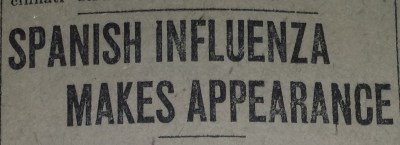
With the current events of the Coronavirus (COVID-19), did you know that Dayton has been through a similar scare before? The Flu Epidemic of 1918 was the Spanish Influenza, aka the “Grip,” which ran rampant among Daytonians. Despite many warnings (almost daily) about the spread of the flu, and tips to stay healthy, more and more Daytonians were getting sick.
Tag Archives: Dayton history
Mead Corporation
The Mead Corporation was founded in Dayton in 1846, by Colonel Daniel Mead and his partners. Originally named Ellis, Chafflin & Company, the paper company went through a series of buyouts and reorganizations over the next several years, until the Mead Paper Company was established in 1882.
- 1856 – Mead bought out his original partners and formed Weston and Mead.
- 1860 – Weston and Mead became Mead and Weston.
- 1866 – Mead and Weston became Mead and Nixon.
- 1873 – Mead and Nixon became the Mead & Nixon Paper Company.
- 1881 – Mead bought out Nixon, and established the Mead Paper Company in 1882.
By the time Daniel Mead died in 1891, the Mead Corporation was one of the largest paper producers in the country, with paper mills in Tennessee, Georgia, and Michigan, as well as the several plant locations in Ohio.
One Missing Bench Found
As you may remember from the story of the Missing Benches, there has been a mystery surrounding the rest of the benches that are supposed to be located all around the Miami Valley.
Well, one of the benches has been located! Right in front of the Wright Brothers Airport in Springboro, with a lovely mural with the Wright Brothers in the background.
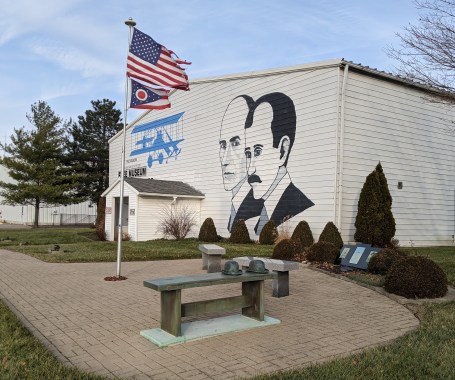
The remaining benches really are a mystery:
- Two at the National Museum of the US Air Force – Bethany spoke to the staff and volunteers (including a groundskeeper) at the museum, and nobody had any recollection of the benches.
- One somewhere at the Dayton International Airport
– no idea where!
Have you seen one of these benches at one of these two locations? We’re still hunting!
More Interesting Street Names
- Wagner Ford Road – Named after the Wagoners, who owned the land where the road forded (was shallow enough to be crossed by wading) the Miami River. Over time, the spelling changed from Wagoner to Wagner.
- Benn Street – named for M.S. Benn, a real estate dealer.
- Siebenthaler Avenue – named for the well-known nursery family.
- Stop Eight Road – The Dayton and Troy Railway had sixteen stops throughout its route. The eighth stop was at Henneke Road, and later renamed Stop Eight Road.
- Wroe Avenue – named after Al Wroe, a Dayton contractor.
- Diamond Mill Road – Named for a mill at the southern end of the road.
- Iroquois Avenue, Wyandot Street, Bannock Street, Blackfoot Street, and Cherokee Drive – named after Native American tribes.
- Michigan Avenue – the road ran alongside the Dayton & Michigan railroad.
- Harman Avenue – named for Gabriel Harman, an owner of the Gebhart Harman Bank.
- Arnold Place – Named for J.O. Arnold, long-time resident, historian and one of the planners of the Dayton View neighborhood.
This Day in History – February 2nd, 1923
On February 2, 1923, the first leaded gasoline was sold in Dayton, Ohio.
Thomas Midgley, a chemist, worked with Charles Kettering at General Motors Research Corporation. Kettering had modified an internal combustion engine to produce greater horsepower, but it resulted in “engine knocking.” Midgley added tetraethyl lead to the fuel, which eliminated the problem. Kettering named the mixture “ethyl gas” and they first sold it at a station owned by Kettering’s friend, Willard Talbott. The gas was a success.
Unfortunately, leaded gas was toxic to humans and the environment. Workers in plants producing the gas were exposed to lead poisoning. Many died and others went mad. The gas was eventually phased out in the 1970s when the federal standards became stricter.
This Day in History – January 25th, 1978
On January 25, 1978, a severe blizzard blew in to Dayton, a result of two storm systems meeting and combining over Ohio. The storms created a megastorm and impacted the Great Lakes Region, mainly Ohio. Wind gusts were recorded in Dayton up to 70 mph, 5 miles faster than the 65 mph requirement for a storm to be considered a tornado. The National Weather Service issued a blizzard warning that night at 9 pm.
The total amount of accumulation in Dayton was more than forty inches in January. More than a foot fell on just one day, January 26th. Volunteers dug out people stranded in cars and transported them to safe shelters that were set up. The situation was so severe that Governor James Rhodes sent the National Guard in to bring supplies and help rescue stuck motorists.
Most Dayton residents were unable to get to work, and for the first time since the 1913 Flood, mail was not able to be delivered. The airport ceased all air traffic at Cox International Airport and the RTA did not put any busses on the street. Travel agencies saw record bookings for cruise ships and warmer climate destinations. Some parts of the state still had snow until May.
Fire at the Requarth Lumber Company
When fire ignited the Requarth Lumber Company building at 2 am, only two firefighters responded to the call. Not long after, there wear 77 firefighters and 18 pieces of equipment to battle the blaze. Sightings of the fire were reported to be seen as far away as Preble and Darke Counties, 10 miles away.
Requarth incurred $650,000 in damages, but firefighters were able to save most of the main building. The storage sheds were almost completely destroyed. At first, faulty equipment was blamed for the blaze but soon after, it was discovered that arson was the cause. Samuel Edward Ross, who was a patient from the Dayton Mental Health Center, started the fire in the storage yard at the west corner.
Requarth Lumber Company
“Bought lumber for making ribs and uprights from Requarth Co..” – Orville Wright in his journal, January 19, 1904
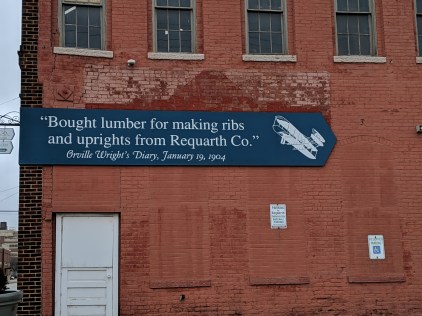
Requarth Lumber was founded by Frederick August Requarth and Henry W. Meyer in 1860 as a small turning shop at Fourth Street and Wayne Avenue. They eventually moved to 447 East Monument Avenue in 1895, and have stayed there since.
This Day in History – August 29th, 1876
On August 29, 1876, Charles F. Kettering was born in a farmhouse near Loudonville, Ohio. After graduating high school, Kettering taught at rural schools to save for college tuition. He enrolled at the College of Wooster but had to drop out due to problems with his eyesight. He returned to teaching until he enrolled at Ohio State University, but again he had to drop out due to his eyesight. After a brief stint as a lineman, Kettering returned to Ohio State, this time graduating with a Bachelor’s degree in mechanical and electrical engineering.
As an engineer, Kettering invented an electric cash register that eliminated the need for a hand crank, developed the first self-starting auto ignition system, and organized the Dayton Engineering Laboratories Company (Delco). Kettering had more than 140 patents.
This Day in History – June 27th, 1872
Paul Laurence Dunbar was born on June 27, 1872 in Dayton, Ohio on Howard Street. His parents were former slaves who escaped from Kentucky, then met in Dayton after the war. He published his first works in 1892 while working as an elevator operator. Overall, Dunbar wrote twelve books of poetry, four books of short stories, five novels, and a play before his death in 1906.
My lady love lives far away,
And oh my heart is sad by day,
And ah my tears fall fast by night,
What may I do in such a plight.
And oh my heart is sad by day,
And ah my tears fall fast by night,
What may I do in such a plight.
Why, miles grow few when love is fleet,
And love, you know, hath flying feet;
Break off thy sighs and witness this,
How poor a thing mere distance is.
My love knows not I love her so,
And would she scorn me, did she know?
How may the tale I would impart
Attract her ear and storm her heart?
Calm thou the tempest in my breast,
Who loves in silence loves the best,
But bide thy time, she will awake,
No night so dark but morn will break.
But though my heart so strongly yearn,
My lady loves me not in turn,
How may I win the blest reply
That my void heart shall satisfy.
Love breedeth love, be thou but true,
And soon thy love shall love thee, too;
If Fate hath meant you heart for heart,
There’s naught may keep you twain apart.
 Dayton Unknown
