
During his time teaching, August studied the Allen Quarry tucked away in Centerville (where the Rod & Reel Fishing Club is now), and identified and named the formation there, and discovered a new classification of limestone – which he named the Brassfield limestone. He was also responsible for naming a rock formation the Beavertown Marl at the quarry site at Wilmington Pike and Dorothy Lane. August had found his specialty, and many fossils found in the Centerville area were named by him.
Continue reading
Category Archives: Prominent Local Figures
The Tragic Life of Enos Doolittle and his Doolittle Tavern
Have you bought Sara’s Book yet?
Murder & Mayhem in Dayton and the Miami Valley came out last June, featuring many true crime stories in Dayton from the 1800s and early 1900s.
You can buy an autographed copy directly from Sara here!
Also stay tuned for a post soon with some teasing previews of the stories in the book!
Tonja Buford-Bailey
Her successes led to three trips to the Olympics – Barcelona in 1992, Atlanta in 1996, and Sydney in 2000. When Tonja made the team in 1992, she was just 21 and was the second youngest Olympian from the U.S. to be sent to Spain. Once the Dayton Daily News published an article about Tonja going to Barcelona, it was publicized that her mother wouldn’t be able to afford the trip to Spain. The article spurred Daytonians on to donate funds to pay for the trip, and Tonja’s mother was able to see Tonja compete.
Edith Deeds
Continue reading
Benjamin Archer
Archer purchased over 500 acres of land near Clyo Road and Alex-Bell Road – which was originally outside of Centerville’s city limits. Archer came back to Ohio in 1798 to settle with his family.
Continue reading
Ida Weller
In 1893, At the age of 17, Ida graduated from the Washington Township High School on West Franklin Street. The building still stands today, and until recently, was the Las Piramides Mexican restaurant. Two years later at the age of 19, Ida earned her teaching certificate from Ohio Northern College and from 1895-1897, Ida taught at Schoolhouse Number 8, which was located at McEwen Road and State Route 725.
Continue reading
William Walton
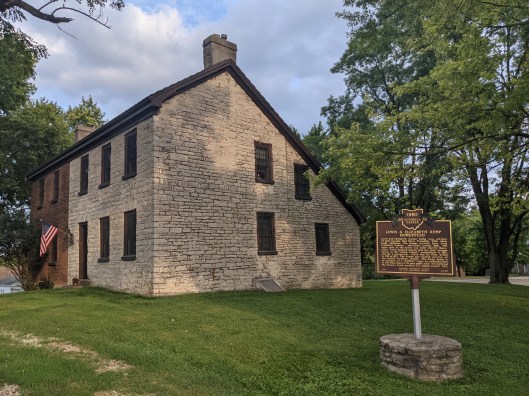
While driving through Centerville, have you ever spotted a tiny sign – “Walton House Museum” and wondered what it was? So have we! As it turns out, this stone house was built in 1838 by Henry Reese, who bought the parcel of land from one of Centerville’s founders, Benjamin Robbins. Eventually, William Walton and his wife Miriam (known as Mary) bought the house in 1927.
William Walton was born April 1st, 1876 to Samuel and Mary Walton. William was the grandson and great-grandson of the founders of Spring Valley, Moses and Edward Walton. Also, William’s older sister Edith married Colonel Edward A. Deeds and later created the beloved Deeds Carillon Bells.
More Fun Dayton Facts
- In 1920, Dayton had no unsolved murders.
- During WWII, Lieutenant Harry Zavakos was reported MIA and presumed dead after his plane was shot down over China. He was actually found by the Chinese and slowly moved across the country to be returned to his unit. During the time the Chinese transported Zavakos, they continually fed him fried chicken.
- Flight personnel gave Dayton the moniker “The Popcorn City” due to the popcorn sold at Wileswood Country Store. Some ground crews would refuse to work on aircrafts if the flight crews did not return from a trip to Dayton with “Dayton popcorn.”
- In 1979, while excavating for the Gem Savings headquarters, the skeleton of an adult male was discovered. The site was originally the location of Dayton’s first cemetery. Since the bodies had never been moved from the location, one theory is that this particular skeleton was John Davis, an early Dayton pioneer.
- Dayton’s most successful professional sports team was the Dayton Gems, a hockey team that played in Dayton from 1964 to 1977.
- Electricity was introduced in Dayton in 1882, when the first electric light turned on in the Dayton Morning Journal office.
- Ponderosa Steakhouse, which was founded in Indiana, moved its headquarters to Dayton in 1968, where it flourished for decades.
- During WWII, there was such a drastic labor shortage in Dayton, that a job draft was considered to fill the positions.
Lewis Kemp and the Oldest House in Dayton
