This article was published in The Wyandot Pioneer (Upper Sandusky, Ohio) on Friday, June 4th, 1847.


Johnny Newton Morehouse was born in 1855, the youngest son of John Newton Morehouse Sr. and his first wife, Mary Margaret (Browning) Morehouse. John and Mary were married December 23, 1851. Johnny’s older brother Horace Morehouse was born in 1852, also in Ohio.
John Newton Morehouse was born in 1828. He was a shoe cobbler until his death in 1903. In 1851 he married Mary, his first wife and mother to Horace and Johnny. They divorced and by the time Johnny died in 1860, John was married to his second wife, Barbara. After Barbara died in 1878, John lived a low-profile life as both a shoe cobbler and an active member of his church. He never remarried and remained in Dayton until his death in 1903.
Mary Margaret Browning remarried on October 25, 1870, to Nathaniel B. Young. Together, Nathaniel and Mary had two children, Jack Diamond Young (1870) and Nathaniel B. Young Jr. (1876). Eventually Mary, her husband, and the kids moved to Fort Wayne, Indiana. Nathaniel Sr. and his stepson Horace went into business together but had to declare bankruptcy in 1877. Mary and her family eventually moved to Washington where she lived until her death in 1927.
Horace moved to Fort Wayne, Indiana with his mother, stepfather, and half siblings and worked in the clothing business as a tailor. On January 8, 1889, he married the recently widowed Alice Wood (Van Phul) after a brief and secret courtship, which caused a major scandal and led to the Cincinnati Sun writing a smear article about it. (Read about it here).
By the end of February 1889, Alice alleged that Horace had abandoned her and filed for divorce. After three years of “abandonment” Alice was granted her divorce. Years later, Horace married Kitty Gilbert and shortly after, they had a son. A few years later, Horace moved his family to Seattle, where he became advertising manager for the Seattle Post Intelligencer. Horace died in 1898 after a 5-week illness.
Fun fact – we gathered the most recent census information available and tallied it up to compare to our beloved Dayton:
Dayton, Ohio – population of 137,644
Other Daytons – total combined population of 126,837
The storm, described as less than a tornado and more of a “big wind”, blew through “creating great havoc in property and destroying precious human lives. The storm, which was a furious one, lasted about 30 minutes. It began in the northwest with a sultry atmosphere and a temperature of 96 degrees. About 2 p.m. there were angry growlings and menacing streaks of lightning above the horizon. There were a few drops of rain, a sudden rush of wind and the storm came on furiously. Branches fluttered in the air, shade trees went down in the gutters, signs were flung about like flails, great steeples, by the wind, swung to and fro like the tops of tall pine trees. The thunder was terrific, the lightning vivid, the wind most furious and the rain poured down as though the flood-gates of heaven had opened for a deluge.”
Continue reading

E. E. Alderman, a Daytonian interested in short wave reception, relayed thousands of messages to families during WWII. Families received news of whether their loved ones had died, were prisoners, or were coming home. By doing this for the Dayton community, it is estimated that he relayed messages to over 9,000 families.
As a result of this, one of our readers reached out to us to share two postcards that E.E. Alderman sent about his grandfather, Private G.M. Brown.
The first postcard, dated December 12, 1944, was addressed to the postmaster of Canandaigua, New York to notify the kin of Brown’s capture by the Germans.


The second post card was to Brown’s sister Doris, dated December 22, 1944. This message thanked her for her contribution to Alderman’s endeavors and notifying her that her brother was safe and well, although still a Prisoner of War.
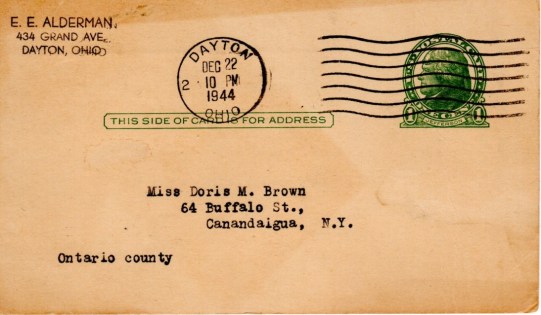
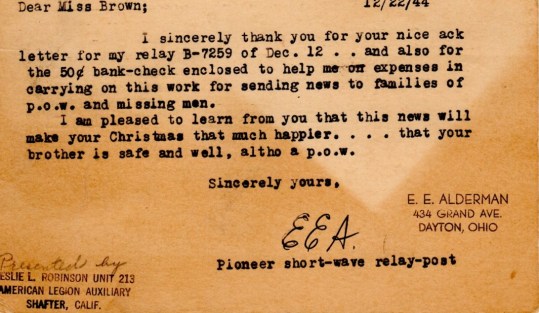
Our reader, Pete Granger, has donated these postcards and many other documents related to his grandfather’s service to the National Infantry Museum & Soldier Center.
John Newton Morehouse, Jr. (known as Johnny) was born in 1855, the younger son of John Newton Morehouse, Sr., and Mary Margaret (Browning) Morehouse. John and Mary were married December 23, 1851. John Sr. was a shoe cobbler and the family lived in the back of their shoe repair store. By the time of Johnny’s death on August 14, 1860, John Sr. was divorced from Mary and married to Barbara, his second wife.
Launched using a dolly-and-track system (similar to how the first flight was launched), the Bug was capable of striking targets up to 75 miles away and could travel at speeds of 50 miles per hour. The Bug consisted of an engine, fuselage, and wings and cost about $400 each to produce. The fuselage was made out of papier-mache and wood laminates, and the wings were built out of cardboard. The Bug also had a small onboard gyroscope to guide the Bug to its target.
Continue reading
More Street Names:
 Dayton Unknown