Recently we learned he is officially [finally] honored on The Officers Down Memorial Page, just in time for the 151st anniversary of his death, which was October 31st. The next step (which is in process now) will be to submit paperwork to the committee for the National Law Enforcement Officers Memorial. If approved, his name will be engraved on the marble wall in Washington DC.
Constable J. William Fogwell
End of Watch Thursday, October 31, 1872
Other Daytons (Part 2)
- Dayton, Nevada – the second-oldest settlement in Nevada and home to the oldest hotel in Nevada, and once a hotspot for gold miners. Named for a local surveyor, John Day in 1861.
- Dayton, Newark, New Jersey – a neighborhood in Newark, named after Jonathan Dayton.</
- Dayton, New Jersey – an unincorporated community in South Brunswick. Originally known as Cross Roads but was renamed to Dayton in 1866, but it is unclear if it is named for William L. Dayton or Jonathan Dayton.
- Dayton, New York – founded around 1810 when settlers arrived and mistakenly thought they were in Chautauqua County (but they were in Cattaraugus County). Formed from the town Perrysburg.
- Dayton, Oregon – founded in 1850 by Joel Palmer and Andrew Smith, a native of Dayton, Ohio.
- Dayton, Pennsylvania – a small borough in Armstrong County. Population as of the 2020 census was 549 people.
- Dayton, Tennessee – Settled around 1820 and was named Smith’s Crossroads. Renamed to Dayton in 1877, after Dayton, Ohio. Was also the site of the 1925 Scopes Trial that decided if evolution should be taught in public schools.
A Glimpse of the 1800s
Five Tiny Cemeteries in Beavercreek
- Located on North Fairfield Road, just north of Kemp Road.
- On the site of old Mount Pisgah German Reformed Church, which held services as early as 1809.
- The cemetery is also known as Old Pisgah Cemetery.
- The land was owned by Jonathan Harshman.
- The earliest known burial was John Helmer in 1823.
- Surnames of Cyphers, Goldshot, Harshman, Howett, Koogler, Reigelsperger, Sensenbaugh, Swigert, and Trubee are found on the gravestones.
- The last known burial was in 1957.
The Morehouse Family
Johnny Newton Morehouse was born in 1855, the youngest son of John Newton Morehouse Sr. and his first wife, Mary Margaret (Browning) Morehouse. John and Mary were married December 23, 1851. Johnny’s older brother Horace Morehouse was born in 1852, also in Ohio.
John Newton Morehouse was born in 1828. He was a shoe cobbler until his death in 1903. In 1851 he married Mary, his first wife and mother to Horace and Johnny. They divorced and by the time Johnny died in 1860, John was married to his second wife, Barbara. After Barbara died in 1878, John lived a low-profile life as both a shoe cobbler and an active member of his church. He never remarried and remained in Dayton until his death in 1903.
Mary Margaret Browning remarried on October 25, 1870, to Nathaniel B. Young. Together, Nathaniel and Mary had two children, Jack Diamond Young (1870) and Nathaniel B. Young Jr. (1876). Eventually Mary, her husband, and the kids moved to Fort Wayne, Indiana. Nathaniel Sr. and his stepson Horace went into business together but had to declare bankruptcy in 1877. Mary and her family eventually moved to Washington where she lived until her death in 1927.
Horace moved to Fort Wayne, Indiana with his mother, stepfather, and half siblings and worked in the clothing business as a tailor. On January 8, 1889, he married the recently widowed Alice Wood (Van Phul) after a brief and secret courtship, which caused a major scandal and led to the Cincinnati Sun writing a smear article about it. (Read about it here).
By the end of February 1889, Alice alleged that Horace had abandoned her and filed for divorce. After three years of “abandonment” Alice was granted her divorce. Years later, Horace married Kitty Gilbert and shortly after, they had a son. A few years later, Horace moved his family to Seattle, where he became advertising manager for the Seattle Post Intelligencer. Horace died in 1898 after a 5-week illness.
Other Daytons (Part 1)
Fun fact – we gathered the most recent census information available and tallied it up to compare to our beloved Dayton:
Dayton, Ohio – population of 137,644
Other Daytons – total combined population of 126,837
- Dayton, Alabama – Founded in 1832 and nearly destroyed by a tornado in 1852.
- Dayton, California – unincorporated town formerly known as Day Town and Grainland. A post office named Grainland was both established and closed in 1867, reopened in 1873, closed again in 1892 to be opened again in 1893, then closed permanently in 1902.
- Dayton, Idaho – originally known as Franklin Meadows, and was settled in1867 by Joseph Chadwick, who built a log cabin by Five Mile Creek. Named Dayton in 1906.
- Dayton, Illinois (Henry County) – one of the oldest towns in Henry County, and was founded in 1836.
- Dayton, Illinois (LaSalle County) – a very small census-designated place (CDP) named after Dayton, Ohio, as a large amount of the early settlers were from here.
- Dayton, Indiana – formally known as Fairfield until 1830.
- Dayton, Iowa – named after Dayton, Ohio and has a post office that has been in operation since 1877.
The Kettering Bug – The World’s First Drone
Launched using a dolly-and-track system (similar to how the first flight was launched), the Bug was capable of striking targets up to 75 miles away and could travel at speeds of 50 miles per hour. The Bug consisted of an engine, fuselage, and wings and cost about $400 each to produce. The fuselage was made out of papier-mache and wood laminates, and the wings were built out of cardboard. The Bug also had a small onboard gyroscope to guide the Bug to its target.
Continue reading
Peter Sunderland
Peter went on to live a storied life in Centerville.
- In 1799, Peter Sunderland married Nancy Robbins, the daughter of one of Centerville’s founders, Benjamin Robbins in what was the first wedding ceremony to be performed in Washington Township.
- In 1802, Peter and his brother Richard bore witness to the first will filed in Montgomery County.
- In 1803, Peter was the defendant/perpetrator in the first court case in Montgomery County, for assault and battery on a man named Benjamin Scott. The case was held on the upper floor of Newcom’s Tavern. He pled guilt and was fined $6. A year later Scott and Sunderland were back in court, but this time Scott was convicted.
- Sunderland served in the War of 1812.
- Around 1820, a stone house was built on Alex-Bell Road (where Fortis College and Cross Pointe Shopping Center are now). The house had a secret hiding place which was used as part of the Underground Railroad.
- In 1826, a slave from Kentucky known as “Black John” took refuge in the Sunderland house. When a group of men came to “reclaim” John, Peter threatened them and yelled for Black John to escape. Black John ran into the nearby woods and disappeared.
- After hearing a rumor of an Indian uprising, Peter built a large stone springhouse on his property to protect the area. When the land was being cleared in the early 1980s for development, the spring house was rediscovered and subsequently dismantled and reassembled in Stubb’s Park.
Peter Sunderland died October 2, 1841 at the age of 67 years old. He is buried in the Sugar Creek Baptist Church Cemetery in Centerville along with his father, mother, and wife.
The 100th Birthday of MSgt. Richard Gard
Master Sergeant Gard landed on Normandy on D-Day and participated in the breakout from the beachhead through France to Brest. Gard was awarded the Silver Star for gallantry in action during the Battle of the Bulge. He also earned two Bronze Stars, a Purple Heart, and decorations from Bastogne, Belgium, and France.
After Master Sergeant was recalled to active duty for the Korean War in 1950, he earned a degree in Engineering from UD.
A parade in his honor will be held on April 6, starting on Pearhill Drive in West Carrollton. The parade will feature Centerville VFW Post 9550, West Carrollton Police and Fire departments, the Montgomery County Sheriff’s Office, Harold Schnell Elementary, West Carrollton Marching Band, and a flyover from a 1943 PT-19A Cornell warplane by the Butler County Warbirds.
To wish Master Sergeant Gard a happy birthday, please send cards to this address:
MSgt. Richard Gard
c/o 70 Pine Street
Franklin, Ohio 45005.
For more of MSgt Gard’s story, check out this story by Dayton Daily News!
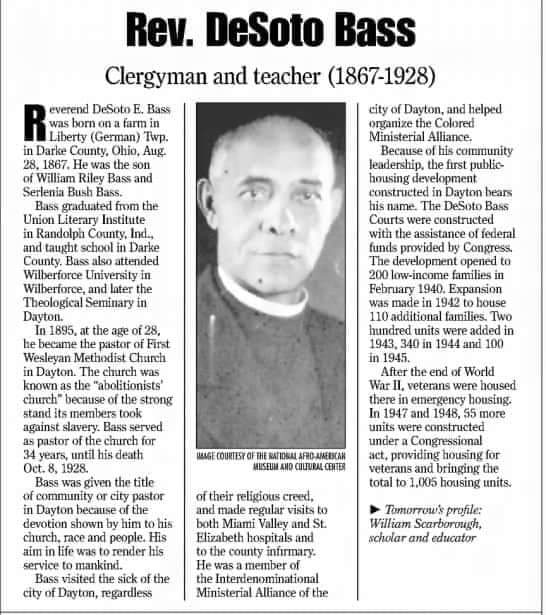
Reverend Desoto Bass
Reverend DeSoto Bass became the pastor of the Dayton First Wesleyan Methodist Church in 1895. The church was known for its abolitionist stance against slavery. Bass served at the church for thirty four years, until his death in 1928.
Bass was known for being “the community’s pastor” because of his devotion to serving the community. He aimed to serve mankind. Bass visited the sick regardless of religion or creed, both in their homes and through regular visits to Miami Valley and St. Elizabeth. Because of his service to the community the first public housing development in Dayton was named for him.
The development opened in February 1940 to house 200 low income families and two years later was expanded to house 110 more families. Over the next few years, 640 more units were added. At the end of WWII, veterans were housed there as emergency housing and within the next few years fifty-five more units were added, bringing the total amount to 1,005 units.