Other Daytons (Part 1)

Did you know that there are 29 other Daytons in the US? Between two posts, we’ll be sharing a bit of information about them.

Fun fact – we gathered the most recent census information available and tallied it up to compare to our beloved Dayton:
Dayton, Ohio – population of 137,644
Other Daytons – total combined population of 126,837

  1. Dayton, Alabama – Founded in 1832 and nearly destroyed by a tornado in 1852.
  2. Dayton, California – unincorporated town formerly known as Day Town and Grainland. A post office named Grainland was both established and closed in 1867, reopened in 1873, closed again in 1892 to be opened again in 1893, then closed permanently in 1902.
  3. Dayton, Idaho – originally known as Franklin Meadows, and was settled in1867 by Joseph Chadwick, who built a log cabin by Five Mile Creek. Named Dayton in 1906.
  4. Dayton, Illinois (Henry County) – one of the oldest towns in Henry County, and was founded in 1836.
  5. Dayton, Illinois (LaSalle County) – a very small census-designated place (CDP) named after Dayton, Ohio, as a large amount of the early settlers were from here.
  6. Dayton, Indiana – formally known as Fairfield until 1830.
  7. Dayton, Iowa – named after Dayton, Ohio and has a post office that has been in operation since 1877.
  8. Continue reading

The Kettering Bug – The World’s First Drone

In 1917, the US Army asked Charles F. Kettering to design an unmanned “flying machine” which could hit a target from 40 miles away. Kettering designed the Kettering Aerial Torpedo (later known as the Kettering Bug) and it was built by the Dayton-Wright Airplane Company, with Orville Wright acting as the aeronautical consultant on the project. The Kettering Bug was a predecessor of today’s cruise missiles and UAVs.

Launched using a dolly-and-track system (similar to how the first flight was launched), the Bug was capable of striking targets up to 75 miles away and could travel at speeds of 50 miles per hour. The Bug consisted of an engine, fuselage, and wings and cost about $400 each to produce. The fuselage was made out of papier-mache and wood laminates, and the wings were built out of cardboard. The Bug also had a small onboard gyroscope to guide the Bug to its target.
Continue reading

Peter Sunderland

Samuel Spencer born on April 14th, 1698 in Yorkshire England. Born to the 3rd Earl of Sunderland Charles and his commoner wife Judith, Samuel was not entitled to any inheritance or title due to his mother’s status. This led Samuel and his family to immigrate to the United States in 1737 with his children, including son William. The family all took on the surname Sunderland upon their arrival in the United States. In 1770, William Sunderland married Sarah Barraclough in Burlington County, New Jersey. William and Sarah eventually came to Ohio in 1795 along with their 18-year-old son, Peter.

Peter went on to live a storied life in Centerville.

  • In 1799, Peter Sunderland married Nancy Robbins, the daughter of one of Centerville’s founders, Benjamin Robbins in what was the first wedding ceremony to be performed in Washington Township.
  • In 1802, Peter and his brother Richard bore witness to the first will filed in Montgomery County.
  • In 1803, Peter was the defendant/perpetrator in the first court case in Montgomery County, for assault and battery on a man named Benjamin Scott. The case was held on the upper floor of Newcom’s Tavern. He pled guilt and was fined $6. A year later Scott and Sunderland were back in court, but this time Scott was convicted.
  • Sunderland served in the War of 1812.
  • Around 1820, a stone house was built on Alex-Bell Road (where Fortis College and Cross Pointe Shopping Center are now). The house had a secret hiding place which was used as part of the Underground Railroad.
  • In 1826, a slave from Kentucky known as “Black John” took refuge in the Sunderland house. When a group of men came to “reclaim” John, Peter threatened them and yelled for Black John to escape. Black John ran into the nearby woods and disappeared.
  • After hearing a rumor of an Indian uprising, Peter built a large stone springhouse on his property to protect the area. When the land was being cleared in the early 1980s for development, the spring house was rediscovered and subsequently dismantled and reassembled in Stubb’s Park.

Peter Sunderland died October 2, 1841 at the age of 67 years old. He is buried in the Sugar Creek Baptist Church Cemetery in Centerville along with his father, mother, and wife.

The 100th Birthday of MSgt. Richard Gard

Family and friends of Master Sergeant Richard Gard are asking for help honoring him for his upcoming 100th birthday. They are collecting cards to present to him on his birthday, coming up on April 6th.

Master Sergeant Gard landed on Normandy on D-Day and participated in the breakout from the beachhead through France to Brest. Gard was awarded the Silver Star for gallantry in action during the Battle of the Bulge. He also earned two Bronze Stars, a Purple Heart, and decorations from Bastogne, Belgium, and France.

After Master Sergeant was recalled to active duty for the Korean War in 1950, he earned a degree in Engineering from UD.

A parade in his honor will be held on April 6, starting on Pearhill Drive in West Carrollton. The parade will feature Centerville VFW Post 9550, West Carrollton Police and Fire departments, the Montgomery County Sheriff’s Office, Harold Schnell Elementary, West Carrollton Marching Band, and a flyover from a 1943 PT-19A Cornell warplane by the Butler County Warbirds.

To wish Master Sergeant Gard a happy birthday, please send cards to this address:
MSgt. Richard Gard
c/o 70 Pine Street
Franklin, Ohio 45005.

For more of MSgt Gard’s story, check out this story by Dayton Daily News!

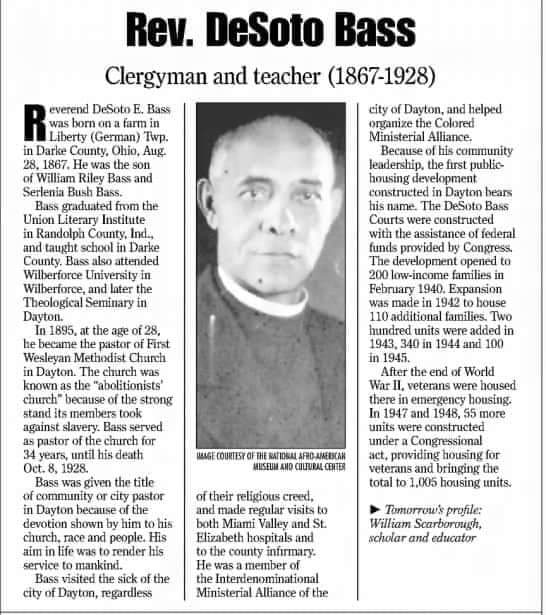
Reverend Desoto Bass

Maybe you’ve heard of the DeSoto Bass apartment complex, known as “the Bass” But do you know how it got its name?

Reverend DeSoto Bass became the pastor of the Dayton First Wesleyan Methodist Church in 1895. The church was known for its abolitionist stance against slavery. Bass served at the church for thirty four years, until his death in 1928.

Bass was known for being “the community’s pastor” because of his devotion to serving the community. He aimed to serve mankind. Bass visited the sick regardless of religion or creed, both in their homes and through regular visits to Miami Valley and St. Elizabeth. Because of his service to the community the first public housing development in Dayton was named for him.

The development opened in February 1940 to house 200 low income families and two years later was expanded to house 110 more families. Over the next few years, 640 more units were added. At the end of WWII, veterans were housed there as emergency housing and within the next few years fifty-five more units were added, bringing the total amount to 1,005 units.

Source

Mad Anthony Wayne and the Longest Grave Ever

Mad River, the former Wayne Township (now Huber Heights), Wayne High School, and Wayne Avenue are all named for Major General “Mad” Anthony Wayne. General Wayne served in the Revolutionary War and the Northwest Indian War. His most famous victory from the Revolutionary War was leading a bayonets-only attack against the British at Stony Point, New York. During the Northwest Indian War, he helped defeat the Indian Confederacy at the Battle of Fallen Timbers and negotiated the Treaty of Greenville in 1795.

There are many theories how Anthony Wayne earned the moniker “Mad” Anthony Wayne. One theory is that it came from his impulsive decisions during battles. Another theory involves another prominent name in Dayton History, James Wilkinson. In 1792, Wilkinson and Wayne were in competition for commander of the Legion of the United States. When Washington appointed Wayne, Wilkinson attempted to discredit and criticize Wayne at every opportunity, even calling him “Mad” Anthony Wayne, hoping it would catch on with the general public.
Continue reading

More Street and Bridge Honorary Designations

This list is thanks to the book Hidden History by Tony Kroeger, with a small amount of Googling on our part.

  • Chuck Whalen Lane (L Street) – Whalen was a UD graduate who went on to serve as a US Representative
  • Local 696 Way (Alwildy Drive) – United Auto Workers Local 696 has an HQ building on Alwildy, which was designated by Paul Deneau in 1965.
  • Bishop John H. Mathews Jr. Way (College Street) – Mathews was a pastor of Mount Zion Church.
  • Keith A Byars Sr. Way (Hoover Avenue) – Byars is a Dayton native who played in the NFL for 13 seasons as fullback and tight end. He played seven seasons for the Eagles, made the Pro Bowl in 1993 with the Dolphins, then SuperBowl XXXI with the New England Patriots.
  • Commissioner Richard a Zimmer Memorial Bridge (Findlay Street Bridge) – Zimmer was a Dayton City Commissioner for 21 years.
  • Dean Lovelace Drive (Madden Hills) – Lovelace was a Dayton City Commissioner.
  • Martin Bayless Drive (Enroe Drive) – Bayless is a Dayton native who played in the NFL for 13 seasons for: St Louis Cardinals; Buffalo Bills; San Diego Chargers, Kansas City Chiefs, and Washington Redskins. He is now a Director of Player Development and General Manager at Brevard College.

Katharine Wright Haskell

The youngest of the seven Wright Children, Katharine Wright Haskell was an amazing person and she needs more credit.

When Katharine was 15, her mother Susan died of tuberculosis, leaving Katharine to care for her entire family on her own. Katharine was the only surviving daughter and the responsibility for caring for the household fell to her. Despite the amount of work she had to do at home, Katharine persisted in her studies at Central High School and attended Oberlin College. She graduated in 1898 as one of the few co-ed students in the US at the time and the only child of Susan and Milton to have a college education. She took a position teaching Latin at Steele High School and hired a maid to help with household chores.

Continue reading

Roger Glass

CEO and President of Marion’s Pizza Roger Glass passed away on August 24th. Roger’s father, Marion Glass, was the founder of Marion’s Piazza in 1965. Roger took over in 2006 when his father died. Roger wasn’t just known for his business, he was also a community leader and donated to many charities and causes.

Roger was well known in the community as a philanthropist. Most recently, Roger donated money to University of Dayton, his alma mater. His donations helped fund the future Roger Glass Center for the Arts and his donations to Chaminade Julienne funded Roger Glass Sports Stadium.

Roger split his time between Oakwood and Lauderdale-by-the-sea, Florida. In both areas, Roger was an active member of the community and philanthropist. He served on various boards, both charitable and professional. He was an avid fan of local sports, including the UD Flyers and Dayton Dragons.

Roger has been interred in Calvary Cemetery alongside his parents. He will be remembered and missed as a generous friend and a kind human being.

Street and Bridge Honorary Designations

Perhaps you’ve seen the blue street signs above the regular street signs with names on them. Did you recognize the names? Did you wonder who they were or what they did? Here’s a list of many from around the Dayton area.

This list is thanks to the book Hidden History by Tony Kroeger, with a small amount of Googling on our part.

  • Page E. Gray Jr. Way (Liscum Drive) – Gray was the first African American to hold a position other than custodian at NCR. He was a parts inspector and later became an assistant design engineer during the 1960s.
  • Mick Montgomery Way (Patterson Boulevard) – Montgomery owned Canal Street Tavern.
  • Betsy B. Whitney Way (Wilkinson Street) – Whitney was a philanthropist and volunteered for many causes, including the YWCA, which is located on Wilkinson.
  • Paul Deneau Way (Fourth Street) – Deneau was an architect of several Dayton buildings, such as the Grant-Deneau Tower at 40 W. Fourth Street and the Lakewoods Tower at 980 Wilmington Avenue.
  • Ambassador Richard Holbrooke Memorial Bridge (Salem Avenue bridge) – Holbrooke was an American diplomat and a leader in the development of the Dayton Accords in 1995, which helped bring an end to the war in Bosnia.
  • Erma Bombeck Way (Brown and Warren Streets) – Bombeck was a writer whose humorous column and books were widely read. Bombeck grew up in Dayton and is buried at Woodland Cemetery.
  • Mike Schmidt Parkway (Riverside Drive) – Schmidt played in Major League Baseball for eighteen seasons for the Philadelphia Phillies, where he was three-time MVP and 12-time All-Star. He was inducted into the Hall of Fame in 1995.